Isle of Iona - Part One
Every landscape has a story. Every pilgrimage leaves a footprint. Every lesson begins by listening. Welcome to Lessons from the Land, a continuing series exploring the wisdom discovered through sacred travel, personal transformation, and our relationship with the living world.
In my previous blog posts, I shared that my teacher and dear friend, Andrew Steed, will be traveling to Spokane, Washington, for the first time this coming September. Over the past ten years, I have had the privilege of joining Andrew on sacred pilgrimages throughout the British Isles, the United States, Canada, and Jamaica. As we count down to his visit, I thought it would be fun to take a trip down memory lane and share some of these adventures over the coming weeks.
There are places in the world that seem to hold stories within the land itself—places where time slows down and something ancient quietly stirs within us. For me, the Isle of Iona is one of those places.
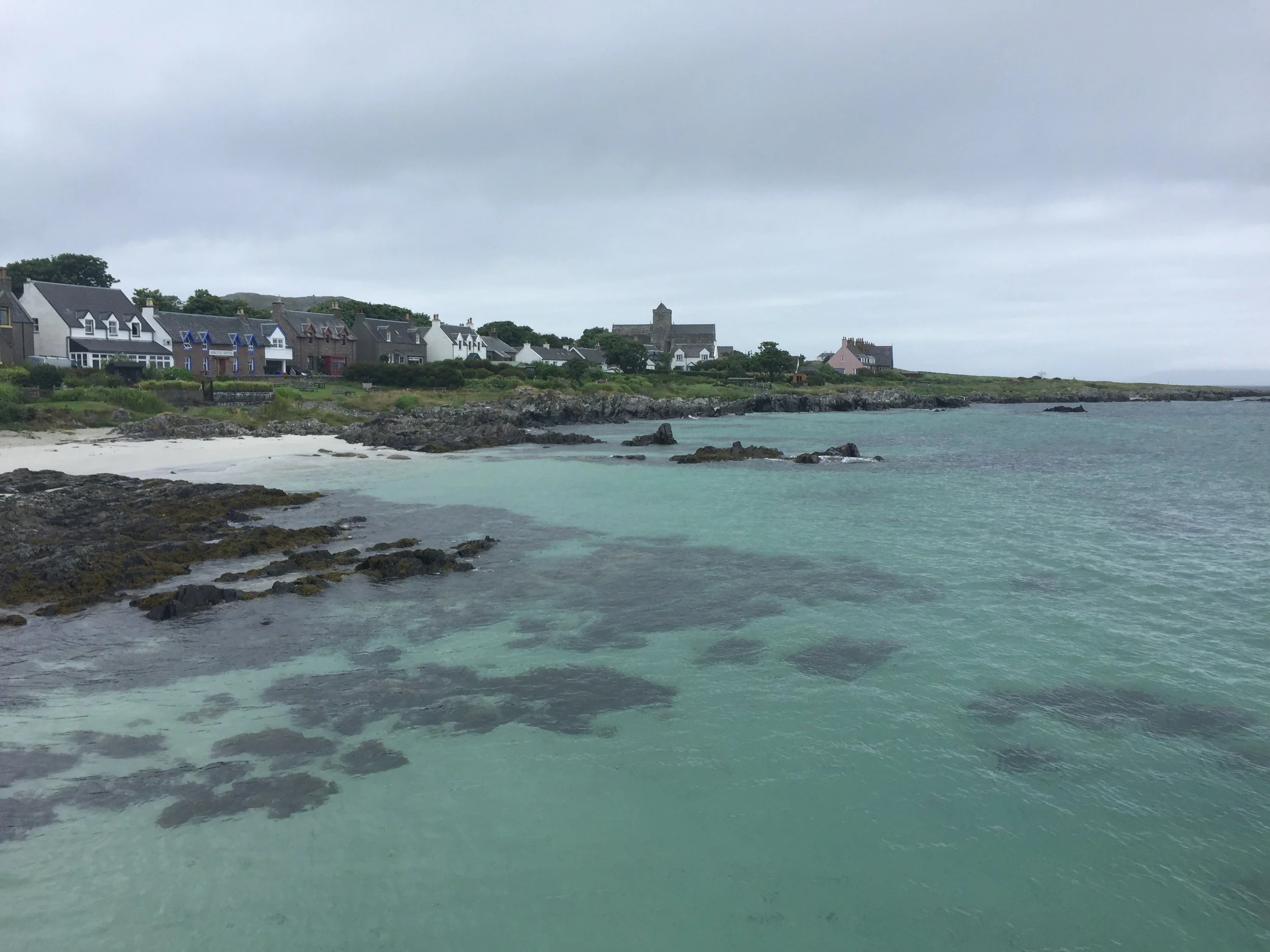
Isle of Iona | View from Ferry
Located off the west coast of Scotland, Iona is a remarkably small island—just three miles long and about a mile and a half wide. Despite its size, it has drawn pilgrims for nearly fifteen centuries. Most visitors come to explore the historic Abbey and Nunnery, established after St. Columba arrived on the island in AD 563. These sacred sites are well worth the journey, offering a glimpse into Iona's rich spiritual history and enduring legacy.
Yet for me, Iona became much more than its remarkable history or beautiful stone buildings.
It became a living classroom.
Over the years, I've come to realize that some of the island's greatest teachings aren't found within the Abbey walls at all, but along quiet beaches, windswept hilltops, hidden coves, and ancient footpaths. It is a place where the landscape itself invites us to slow down, listen more deeply, and remember our relationship with the Earth.
In July of 2016, I stepped onto Iona for the very first time with Andrew Steed and a wonderful group of fellow pilgrims, which included my husband and my two dear friends and their partners. None of us could have imagined just how profoundly that week would shape the years to come.
For such a tiny island, Iona has so much to offer, and Andrew proved to be the perfect guide to introduce us to its landscapes, stories, and mysteries. There was so much packed into our short week on the island that I've decided to tell this story in two parts. Even then, I'll only be scratching the surface.
One of the very first things Andrew invited us to do was to "lay our hearts on the land." We literally lay on the Earth with our hearts against the ground, quietly introducing ourselves to the island. It was a beautiful way to begin the pilgrimage—a gesture of respect, openness, and gratitude. Rather than arriving simply as visitors, we were invited to become participants in a relationship with the land itself. Looking back now, I realize this simple exercise quietly set the tone for everything that followed.
We spent the remainder of the day exploring the peaceful grounds surrounding the Abbey and the ancient nunnery ruins. Little did I know that the following morning would become one of the most memorable experiences of the entire pilgrimage.
Our day began at three o'clock in the morning. In the dark, we quietly made our way toward Dun-I, the highest point on Iona. The climb was steep, rocky, and far more challenging than I had anticipated. Andrew often says that a pilgrimage moves only as fast as its slowest pilgrim. On that morning, I was definitely that pilgrim! Yet something remarkable happened as we continued upward together. Step by step, encouragement replaced self-doubt, and before I knew it, I had climbed farther than I ever imagined possible.
At the summit rests a small heart-shaped pool known as the Well of Eternal Youth (Tobar na h-Aoise), one of Iona's sacred places. Standing there as the first light of morning spread across the island was unforgettable. What followed was a beautiful blessing ceremony unlike anything I had ever experienced. It is one of those memories I continue to carry in my heart nearly a decade later. Perhaps I'll save the finer details of that story for another day, but I can still remember one thing vividly—the shock of the icy Scottish water, even in July!
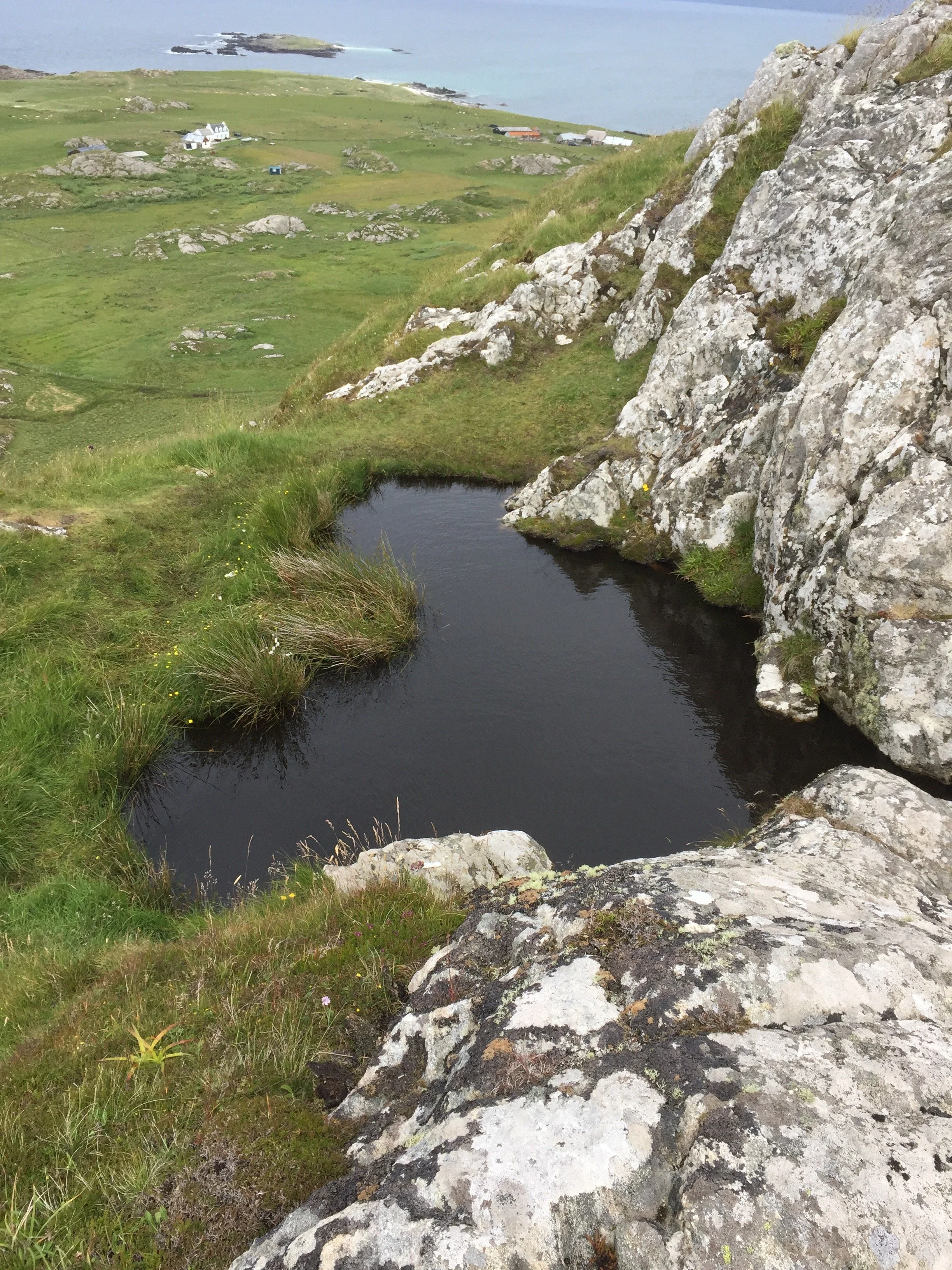
Well of Eternal Youth (Tobar na h-Aoise)
When we completed this part of the day, we headed back to the B&B to rest. After our well-earned naps, we set off for the next part of our adventure. This time, we crossed the rolling green hills of Iona toward St. Columba's Bay, one of the island's most breathtaking and sacred places.
Tradition tells us that this is where St. Columba first stepped ashore after leaving Ireland in AD 563 to establish what would become one of the most influential centers of Celtic Christianity. Legend says that upon arriving, he looked back toward Ireland and could still see his homeland. Determined to fully dedicate himself to his new calling, he continued walking until Ireland disappeared from view before establishing his monastery on Iona. Whether history, legend, or a blend of both, there is something deeply moving about standing in a place where so many pilgrims have paused before you.
Nestled into the grassy hillside overlooking the bay is a simple stone labyrinth. There are no towering walls or elaborate structures—just a quiet path inviting those who enter to slow down, walk with intention, and listen.
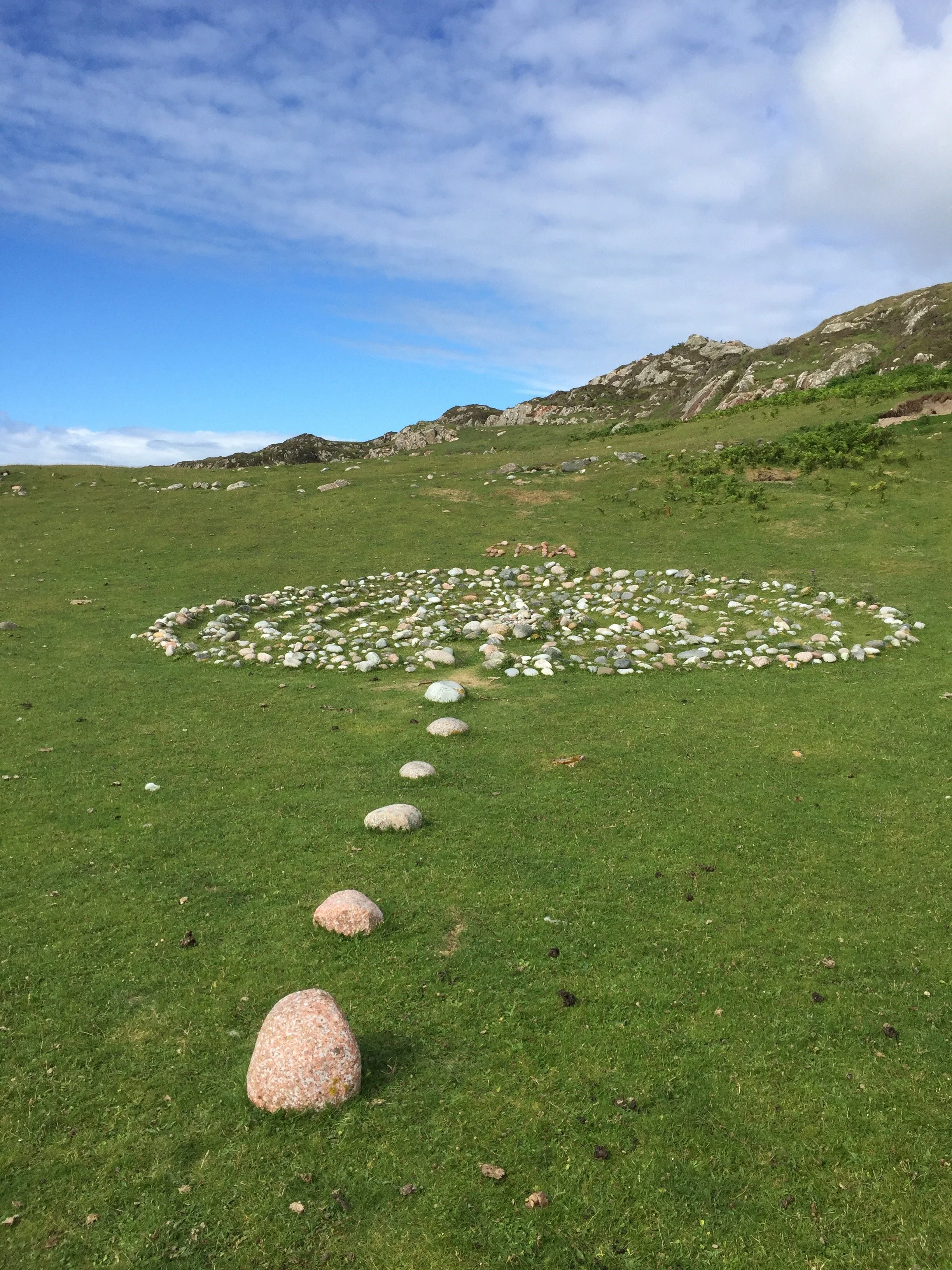
Labyrinth at St. Columba’s Bay
Andrew invited us to walk the labyrinth one at a time, in silence.
At first, I didn't think much about it. I simply began walking.
Almost immediately, however, I became aware of something unexpected. I felt restricted. Almost claustrophobic. Even though I was wearing comfortable hiking boots, I became intensely aware of them with every step. Beneath them was the soft grass, and all I wanted to do was feel the Earth beneath my feet.
But I didn't.
After all, I was wearing hiking boots.
That's what you do.
Or at least, that's what I believed.
With each turn of the labyrinth, that feeling grew stronger until, somewhere along the path, another thought quietly emerged.
"I can do whatever I want."
The realization landed with surprising force.
Without another thought, I untied my boots and enthusiastically tossed them outside the labyrinth with great force. Off came my socks, and for the rest of the walk I continued barefoot, feeling the cool grass beneath my feet with a huge smile stretched across my face. Freedom!
Looking back ten years later, I smile at how simple that moment appears on the surface.
Taking off my shoes.
Hardly a life-changing event.
And yet...
It was.
That labyrinth planted a seed that has continued to grow throughout the past ten years. Sometimes the greatest freedom begins the moment we stop living by the expectations we have unconsciously placed upon ourselves. No one had told me I needed to keep my boots on. That was a rule I had quietly created in my own mind.
The land gently invited me to let it go.
Although I have not yet returned to Iona since that first pilgrimage in 2016, St. Columba's Bay has remained very much with me. The lesson I received while walking that labyrinth has continued to unfold in ways I never could have imagined. It became such an important symbol of my own journey that I eventually chose to have the labyrinth tattooed on my left shoulder—a quiet reminder of the day I gave myself permission to walk my own path.
To be continued in Part Two...
Lessons from the Land
Looking back with ten years of perspective, I can see that the labyrinth wasn't asking me to take off my boots.
It was asking a much deeper question.
What invisible rules have you accepted without ever questioning whether they belong to you?
In 2016, I simply knew that I wanted to feel the grass beneath my feet. I didn't yet understand why that moment felt so significant. Today, I see it differently. That simple act of taking off my boots became one of the first invitations to trust my own inner knowing rather than the expectations I had quietly placed upon myself.
The land has a remarkable way of teaching us in this way. It rarely hands us the answer. Instead, it offers an experience that grows alongside us. Sometimes we don't fully understand the lesson until years later, when we look back and realize that what seemed like a small moment had quietly become a turning point.
Perhaps that's one of the greatest gifts of pilgrimage.
The journey doesn't end when we leave the sacred place.
In many ways...
That's when it truly begins.
See you next week, as we continue on this journey!
With gratitude,
Jenna