Isle of Iona - Part Two
Every landscape has a story. Every pilgrimage leaves a footprint. Every lesson begins by listening. Welcome to Lessons from the Land, a continuing series exploring the wisdom discovered through sacred travel, personal transformation, and our relationship with the living world.
In my previous blog posts, I shared that my teacher and dear friend, Andrew Steed, will be traveling to Spokane, Washington, for the first time this coming September. Over the past ten years, I have had the privilege of joining Andrew on sacred pilgrimages throughout the British Isles, the United States, Canada, and Jamaica. As we count down to his visit, I thought it would be fun to take a trip down memory lane and share some of these adventures. This week, we return to the Iona pilgrimage—although part of this story carries us beyond Iona itself.
Looking back through the photographs from this epic pilgrimage still puts a smile on my face. There were so many special and unique experiences—far too many to fit into two blog posts. For such a tiny wee isle, Iona offered more than I could ever have imagined: my first shamanic journey on a fairy mound; a Quest Day spent roaming the island alone in sacred silence; old Celtic tales shared on the North Beach as a gentle rain passed through; and an exciting journey to the nearby island of Staffa to see Fingal’s Cave.
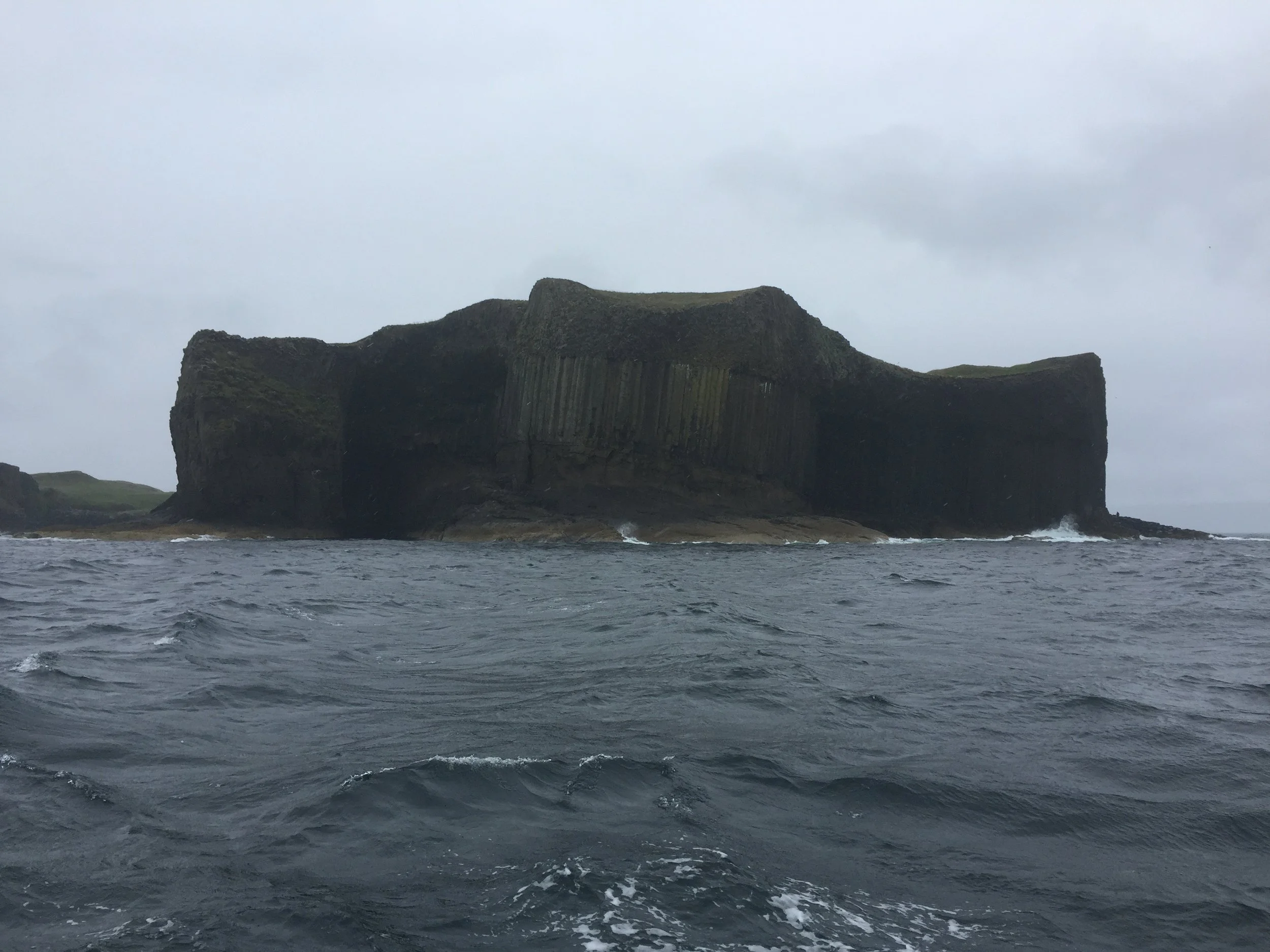
The Isle of Staffa, Scotland 2016
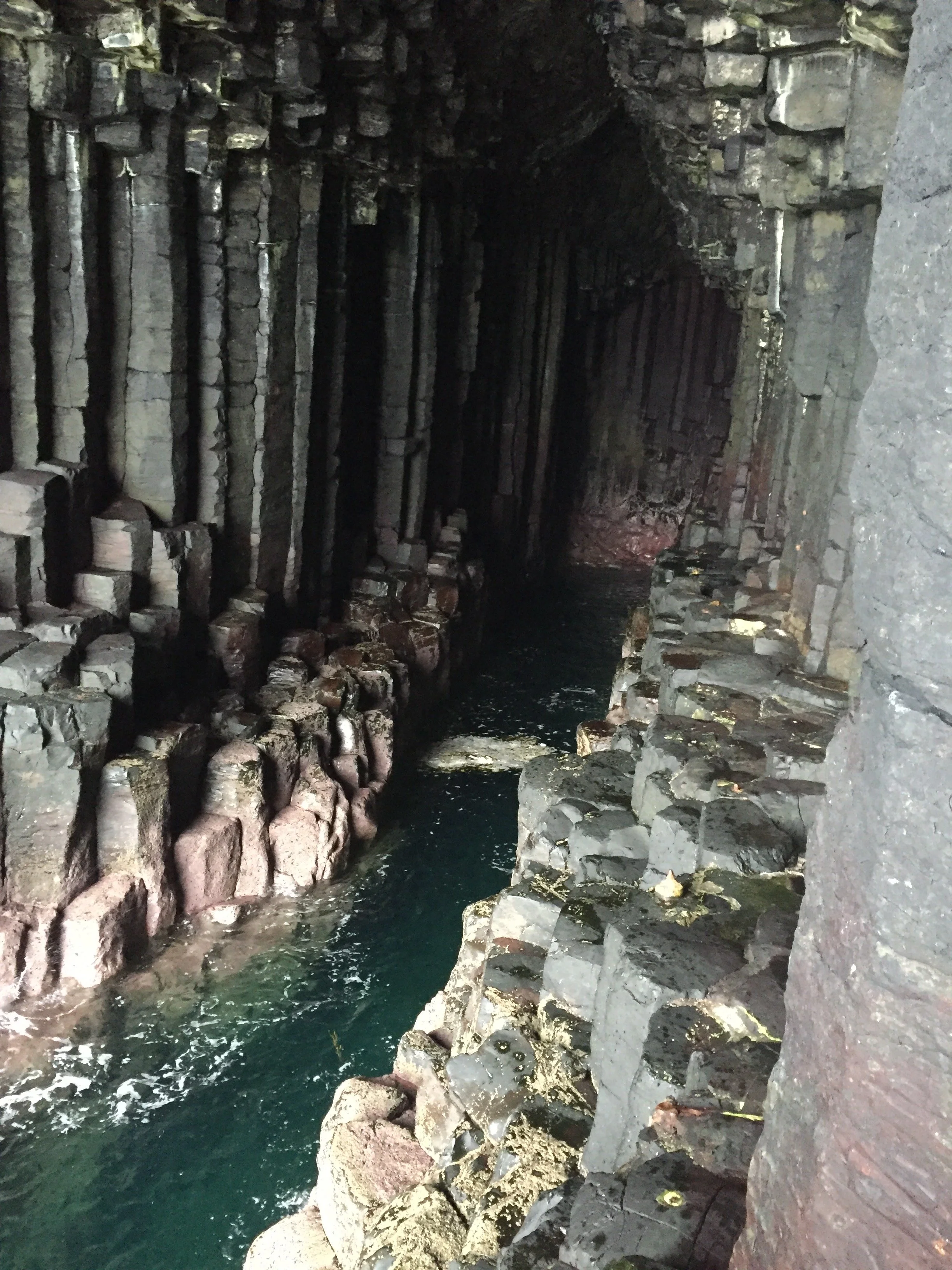
Fingal’s Cave, Staffa, Scotland 2016
With so many memorable moments, deciding what to share has not been easy. But when I reflect on each pilgrimage, I find myself returning to the experiences that inspired the greatest growth. One such experience stands out as I continue this story—and it did not happen on Iona.
Near the end of our pilgrimage, we traveled to Mull and entered a hidden cave known as the Cave of the Dead. Tradition holds that the cave once sheltered the coffins of Scottish kings before their final crossing to be buried on Iona. Because this is a place entrusted to Andrew by local people over many years, I wanted to be thoughtful about how I shared the story without revealing details that were not mine to disclose.
When I asked Andrew for his guidance, he explained:
“The sacred landscapes of Iona, Mull, and Staffa hold many treasures. Just like the Isle of Women was sacred, the masculine also has a sacred space, the Cave of the Dead. The cave is also part feminine, as all caves represent the womb. The womb has held life, death, and rebirth for 48 Scottish kings. The cave is a hidden space for a reason. It is sacred, not secret. So many people do not know how to be in a sacred space.”
It is interesting to note that the “Isle of Women” (Eilean nam Ban in Gaelic) sits close to Iona, and you pass right by it on the boat to Staffa. I recently read that Iona, Staffa, and the Isle of Women form what’s known as a Sacred Triangle. Andrew was right on point—there are many treasures in this area, and I feel incredibly blessed to have had the opportunity to experience such tremendous breakthroughs on these special lands and bodies of water.
I must recall this part of the story from memory; some places are too sacred to photograph. This was much more than a sightseeing trip. It was about meeting the land and allowing the land to help me meet myself. Inside that cave, I experienced a tremendous shift through a medicine way Andrew introduced to us: The Three Strands of Poetry.
Andrew writes about this practice in his books Magical Crows, Ravens, and the Celebration of Death and We Are Children of the Evolution. The Three Strands of Poetry relates to the story of the Dagda’s Harp, an old tale from the Celtic ancestors. He writes,
“In the stories the harp has magical properties; it brings the seasons into order, it prepares one to go into battle, and it plucks the three strands of poetry. ... When we open ourselves as the Dagda’s Harp we can pluck the three magical strands associated with it. These three strands are named sorrow, joy, and peace.
What Spirit guided me to was a way to work with the harp to transmute suffering. I begin by keening, which means to wail, to cry — not crocodile tears, real genuine sorrow. ... It is scary to meet ourselves, to own our own sh*t. Yet when we are willing, we can transform our sh*t into fertilizer.”
I love that concept: transforming our “stuff” into fertilizer. My greatest takeaway from the experience was just how much I had suppressed. What surprised me most was that beneath the Strand of Sorrow, the emotion I had buried most deeply was anger. I later learned that this is not uncommon.
It is interesting to me how society, in general, does not teach or encourage people to process emotion in a healthy way.
I did not realize how much anger I had suppressed throughout my life.
I just continued to stuff it.
Stuff it down, with a smile on my face—pretending that everything was okay on the outside.
The Three Strands of Poetry gave me a way to begin releasing what I had buried. The keen was massive, and although the process was uncomfortable, I believe it became a catalyst for healing, balance, and integration. That healing did not happen overnight. What began in the cave became part of a spiritual journey that continued to unfold between 2016 and 2026. It required time, practice, dedication, and courage. I remain deeply grateful to Andrew and to my beloved companions in the cave, as we held space for one another in our individual healing.
Lessons from the Land
Looking back, I can see now that Iona’s labyrinth had already begun preparing me for what waited in that cave on Mull. The labyrinth taught me something about permission. No one told me to keep my boots on; I had been following a rule I had quietly created for myself. Taking them off became an early invitation to trust my own inner knowing and give myself permission to walk my own path.
The keening asked for another kind of permission: permission to feel what I had buried, permission to give it sound, and permission to stop pretending that everything was fine. The freedom I felt walking barefoot through the labyrinth prepared me, in a small but meaningful way, for the much deeper release that came later.
The labyrinth taught me that I could question the rules that restricted me. The cave showed me that some of those rules lived not only in my thoughts, but also in my body. Healing required more than recognizing them. It required allowing myself to feel what I had spent years pushing down.
What are you holding back because no one ever gave you permission to let it out?
Ten years later, I understand that permission was one of the first medicines the land offered me. First, permission to trust myself. Then, permission to release what no longer needed to be carried.
Sorrow has a strand. So does joy. So does peace. But none of them can move through us until we give ourselves permission to pluck them.
That’s the thread I keep finding, pilgrimage after pilgrimage. The land doesn’t hand us anything new. It simply gives us permission to meet what was already there.
See you next week, where we will step into another pilgrimage and listen for what the land has to teach. Next up: The Isle of Arran!
With gratitude,
Jenna